
Understanding how we got here (and how to fix it)
How did it get this bad? How did our country arrive at this moment? And whose fault is it?
Let’s answer that last one first: If you’re reading this, then you should know that you are most likely not to blame.
Your options at the ballot box have been limited by a system that has, to varying degrees, been failing us our entire lives.
It doesn’t matter who you voted for before now. If we’re going to fix the problems with our country, what matters most is what we do next. And we can all play a role in addressing the root causes that led us to this moment.
But in order to understand how we fix this — how we get back to the America that we once knew and loved – we first have to understand how we arrived at this moment.
From unfavorable to inevitable
Donald Trump did not always enjoy the support and approval of the Republican Party that he now leads. In fact, most conservatives wanted nothing to do with a Trump presidency.
When Trump threw his hat into the ring in the 2016 Republican presidential primaries, his was a unique voice in a field of well over a dozen candidates, each of whom sounded like slightly different versions of the party establishment. And he was polarizing— 59% of voters viewed Trump unfavorably, according to a December 2015 Gallup poll, the single-most unfavorably viewed candidate in the field regardless of party.
If popularity was the most important factor in winning an election like this, Trump would not have had a realistic chance of capturing the nomination. But that’s not how our plurality voting system works.
Republicans in primary election states could only choose one candidate when they voted, and most of them split their votes among the many establishment Republican candidates. But because of how our electoral system works, Trump benefited from that vote-splitting, capturing early primaries with pluralities in the high 20s and low 30s.
The worst-performing candidates dropped out. The field narrowed. But it wasn’t narrowed enough for Trump’s lack of popularity to catch up to him. The establishment vote continued to split among Ted Cruz, Marco Rubio, John Kasich, and Ben Carson. By the time Cruz and Kasich attempted to form a coalition to stop Trump, it was too late.
He had the momentum. His victory became inevitable. Thanks to the vote-splitting flaw in our plurality electoral system, Trump would go on to win the nomination, and ultimately, the presidency.
The MAGAfication of the Republican Party
But that’s not all he won. By becoming president, Trump also became the leader of the Republican Party, controlling half of the two-party system. He purged the party of establishment figures that had not supported him, replacing them with supporters who would obey him without question.
As it turns out, the same flaw in our plurality voting system that had allowed Trump to seize power denied conservative voters any viable alternatives to Trump’s MAGA Republican Party. The party of Lincoln and Reagan became the party of Trump.
In the mid-20th Century, political scientist Maurice Duverget discovered that plurality voting in single-seat elections (such as congressional races) will tend to lead to a two-party system.
The reason is simple: Voters don’t want to waste their votes. That’s why the vast majority of voters will choose one of the two most-popular candidates — they want to ensure that their vote influences the outcome of the election.
That’s why a third political party has never gained enough traction to be competitive in modern American politics, despite nearly two-thirds of Americans wanting a viable third option on the ballot. And that’s why when Trump took control of the Republican Party, voters had nowhere else to go.
If you’re a Republican voter who wasn’t originally a fan of Trump, here are your options today:
Don’t vote at all. But we’ve all been taught that not voting makes us bad citizens and denies us the right to complain about the results of elections. So that’s right out.
Vote third-party. But that means accepting the likelihood that your vote won’t affect the outcome of a given race, which has the exact same amount of influence as not voting at all.
Vote Democrat. For many conservatives, that’s the single-least appealing option on this list. Conservative media and conservative culture have both painted the Democratic Party as the antithesis of what it means to be conservative. And as it turns out, peer pressure works.
Vote Republican anyway, even if you don’t like Trump. This is the route most Republicans find themselves taking for want of any better options.
For most conservative voters, the Republican Party is simply the lesser of two evils. And that’s the only kind of choice that our plurality electoral system allows us to make when we vote.
Voters have been trapped by our system. They’re forced to make unappealing choices between unappealing candidates. And that’s why it’s not all that surprising that 36% of voters sat out the 2024 presidential election, which could end up being the most pivotal election of our lives.
When voters feel like no one represents their values, when neither of the two viable options are appealing, when voting one’s conscience comes with the knowledge that it won’t make a difference — that’s when they stop participating. They give up.
Escaping the two-party trap
Plurality voting is the root cause of American political dysfunction. It incentivizes candidates to run on increasingly extreme platforms during primary races to earn the votes of party hardliners. Its flaws have allowed a minority faction to take complete control over one-half of our political duopoly.
And when voters are limited to “lesser-of-two-evils” choices at the polls, it shapes our political dialogue. It incentivizes candidates to run negative ads against their opponents because it makes looking like the less-bad option the winning strategy.
But the impact of plurality voting’s flaws reach far beyond the ballot box. These flaws have shaped our country’s culture. We have entire media organizations — very successful ones, at that — dedicated to pushing partisan narratives and demonizing opponents. It’s the root of the “us-versus-them” attitudes we see so often in our media and culture.
It has ended friendships.
Torn apart families.
Set one half of our nation at odds with the other.
Ours is the richest country on earth, but it’s on the brink of becoming captured by a faction bent on authoritarian rule because America is running on an 18th Century operating system in the 21st Century. We need to upgrade our democracy to ensure the survival of our country.
A country divided cannot stand. We must unite – not just for the next election, but for the good of our country’s overall future.
That’s why replacing our broken electoral system is a national security imperative.
Fortify Democracy’s north star is preventing authoritarian capture in the United States. If that happens, then that’s the end of America as we know it. That’s why we support electoral reforms that empower candidates with broad appeal while marginalizing candidates that rely on exploiting the flaws in our current system at the root of our divisive politics.
Here’s how we fix it
Our prescription for a better American democracy has three parts:
Implement approval voting in general elections.
Replace partisan primary elections with a single nonpartisan primary in which all candidates and voters take part, with the top four vote-getters advancing to the general election.
Ending the electoral college in favor of a national popular vote. This is a necessary change to make using approval voting possible in presidential elections, but it also ensures that the value of a vote is not geography-dependent.
These reforms would have a moderating effect on the political discourse in our country. They would minimize the influence of extremist and fringe candidates while empowering candidates with broad appeal and make elections marketplaces of ideas.
Approval voting
Approval voting allows voters to select as many candidates in a given race as they want, and each selection carries the same weight. The candidate who gets the most selections wins.
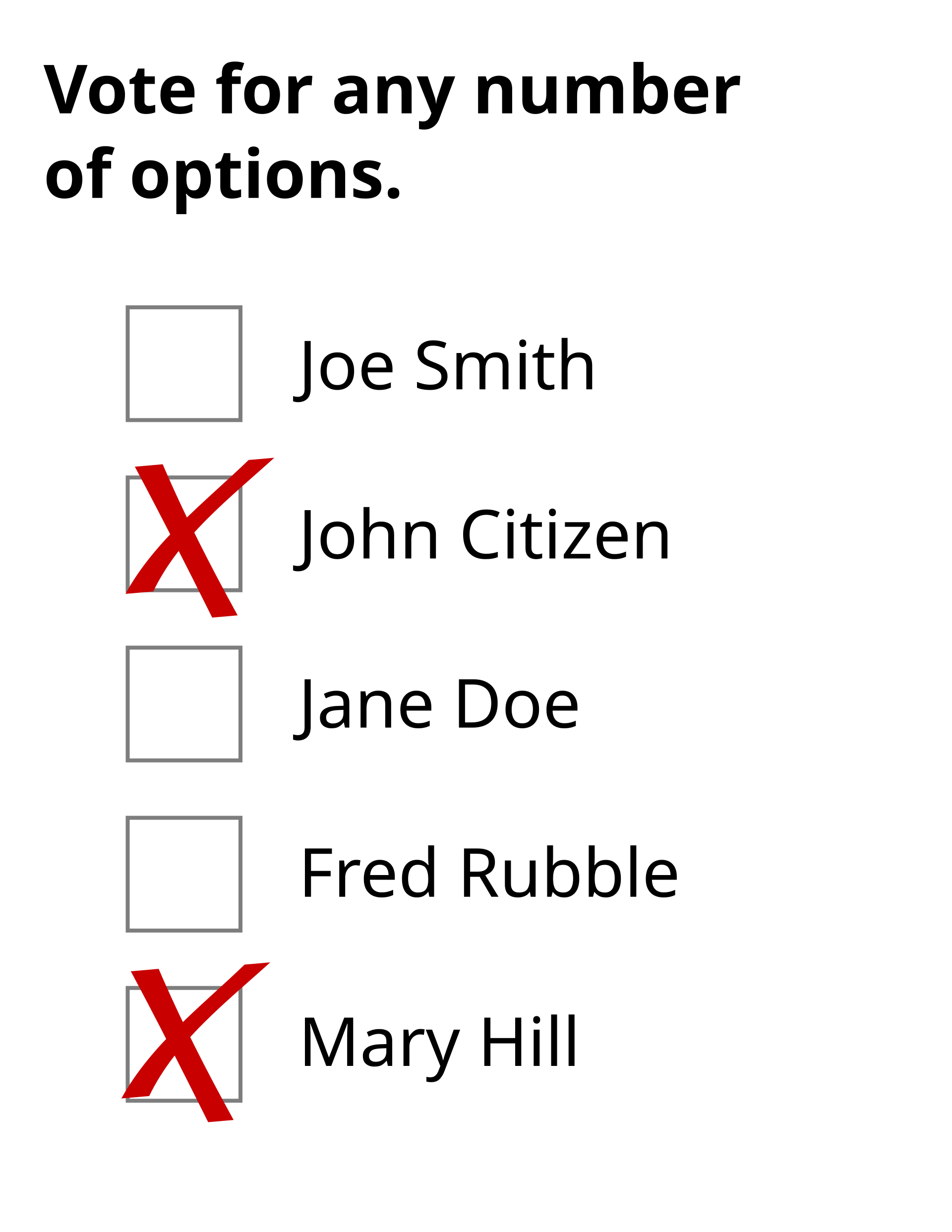
By Rspeer at the English Wikipedia, CC BY-SA 3.0, https://commons.wikimedia.org/w/index.php?curid=567419
This simple change would have a profound – and largely positive — effect on not just our elections, but the entire culture of American politics.
Approval voting:
Incentivizes candidates to seek broad appeal, unlike our current system, which incentivizes divisive rhetoric.
Incentivizes elected officials to pursue policies that improve the lives of their voters.
Incentivizes political parties to police their ranks for corruption, instead of protecting them in the name of political power.
Makes third-party and independent candidacies viable pathways to office, which improves candidate quality overall.
Think about it — how many amazing leaders have we missed out on because they don’t fit the profile of a Republican or a Democrat?
And from the perspective of preventing authoritarian takeover (again, our North Star!), approval voting takes the teeth out of gerrymandering, which is an autocrat’s best friend.
Gerrymandering relies on voters having limited options at the polls. If voters don’t have to choose between the lesser of two evils and can vote for whomever they like, then gerrymandering isn’t a reliable method of creating “safe” seats for political parties.
Non-partisan primaries
Partisan primary elections today encourage candidates to run on ideological purity. This encourages candidates to take on increasingly extreme partisan positions while accusing their opponents of not being in step with the party.
Obviously, that’s a big reason we’re in the situation we find ourselves in today. Partisan primaries incentivize extremism.
By having a single nonpartisan primary election, candidates are forced to appeal to all voters — not just their base. Nonpartisan primary elections have been successfully piloted in Alaska, and have proven to be effective at producing results that are more reflective of the will of the electorate as a whole.
National Popular Vote
If we’re to implement approval voting at the presidential election level, then the electoral college has to go.
But there are plenty of compelling reasons to want a national popular vote, independent of compatibility with approval voting. Among them:
The electoral college suppresses voting in deeply partisan states. If you don’t think your vote matters, you’re less likely to participate.
The electoral college makes votes in one state more valuable than those in another. That’s fundamentally undemocratic and therefore wrong.
The electoral college incentivizes candidates to focus on campaigning only in battleground states, rather than running everywhere. If candidates are only focused on the issues that matter to voters in a handful of states during the campaign, their policies are likely to be reflective of that focus once they’re in office.
Most importantly, the electoral college reinforces the two-party system, which we are actively seeking to end for the good of the nation.
The urgency of now
The 2026 midterm elections will prove critical to the future of our democracy. If the midterms don’t produce a congress that will serve as a check on the executive branch, then we can expect Trump to accelerate his plans for a total authoritarian takeover. We’re talking about the end of American democracy as we know it.
That’s not hyperbole. The president and his administration have told us through their words and their actions that they are not interested in being accountable to the will of the electorate. They know that they’re a minority faction that is only in control because of flaws in our electoral system, and they will fight with all their might to preserve those flaws for future exploitation.
The only way to stop this from happening is to form a coalition dedicated to reforming our electoral system in a way that safeguards it against future attempts at authoritarian capture.
We need conservatives who want real conservative choices at the ballot box to run for office. Any Republican that is willing to fight for American democracy is our ally.
When one party in a two-party system is captured by extremists bent on authoritarian capture, the other party becomes the de-factor resistance. We need Democrats to run on reforming our electoral system to future-proof it against authoritarianism.
We need to give politically homeless independents a reason to believe that their participation will lead to a more representative democracy, one in which their voices and votes matter.
We understand the stakes. We have the solution, but we can’t implement it by November 2026. But what we can do is make it the rallying cry that unites us against the forces that would deny us our rights.
We must take action now. We will vocally support candidates from any party that support our efforts to Fortify Democracy.
We’re fighting for the good of our country - for the good of an America that’s truly united.
Divided we fall.
Let’s unite.